|
SPACE and ASTRONAUTICS
The Bigger Bang
Answering the Ultimate Existential Question
* * *
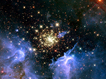
Celebrating the 25th Anniversary of the Hubble Space Telescope
* * *
Blueberries on Mars?
* * *
NASA's Kepler Mission Announces a Planet Bonanza, 715 New Worlds March 2014
* * *
Top Gun Gone Wild?...
No, it’s the new Tom Cruise Sci-Fi movie
OBLIVION
What happens when you cross a Pitts Special with a helicopter? A look at the ultimate VSTOL aircraft in Tom Cruise’s great new sci-fi film OBLIVION
As New York Post movie reviewer Kyle Smith describes it: “At least Cruise does get to fly around an aircraft again: With its round twin gun turrets and a narrow cockpit in between, it looks like a funny nose and glasses, or possibly an intergalactic brassiere.”
Check the links below
Five-minute interview with Tom Cruise
A closer look at the Bubble-Ship design
More on the Bubble-Ship and other production details
* * *
Earth From Space
NOVA on PBS
Full disclosure: I am a huge NOVA fan, having watched it religiously since its inception on March 3, 1974. This special two-hour edition may seem long, but believe me when I say it is more than worth the time. It is brimming with satellite images taken with a vast array of different wavelengths. The resulting visuals are not just stunningly beautiful but enormously revealing from a scientific point of view.--Editor
Program Description
"Earth From Space" is a groundbreaking two-hour special that reveals a spectacular new space-based vision of our planet. Produced in extensive consultation with NASA scientists, NOVA takes data from earth-observing satellites and transforms it into dazzling visual sequences, each one exposing the intricate and surprising web of forces that sustains life on earth. Viewers witness how dust blown from the Sahara fertilizes the Amazon; how a vast submarine "waterfall" off Antarctica helps drive ocean currents around the world; and how the Sun's heating up of the southern Atlantic gives birth to a colossally powerful hurricane. From the microscopic world of water molecules vaporizing over the ocean to the magnetic field that is bigger than Earth itself, the show reveals the astonishing beauty and complexity of our dynamic planet.
The Eagle Has Risen: Stellar Spire in the Eagle Nebula
Appearing like a winged fairy-tale creature poised on a pedestal, this object is actually a billowing tower of cold gas and dust rising from a stellar nursery called the Eagle Nebula. The soaring tower is 9.5 light-years or about 57 trillion miles high, about twice the distance from our Sun to the next nearest star.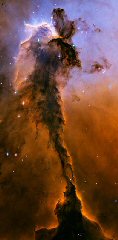
Stars in the Eagle Nebula are born in clouds of cold hydrogen gas that reside in chaotic neighborhoods, where energy from young stars sculpts fantasy-like landscapes in the gas. The tower may be a giant incubator for those newborn stars. A torrent of ultraviolet light from a band of massive, hot, young stars [off the top of the image] is eroding the pillar. (Click image to enlarge.)
The starlight also is responsible for illuminating the tower's rough surface. Ghostly streamers of gas can be seen boiling off this surface, creating the haze around the structure and highlighting its three-dimensional shape. The column is silhouetted against the background glow of more distant gas.
The edge of the dark hydrogen cloud at the top of the tower is resisting erosion, in a manner similar to that of brush among a field of prairie grass that is being swept up by fire. The fire quickly burns the grass but slows down when it encounters the dense brush. In this celestial case, thick clouds of hydrogen gas and dust have survived longer than their surroundings in the face of a blast of ultraviolet light from the hot, young stars.
Inside the gaseous tower, stars may be forming. Some of those stars may have been created by dense gas collapsing under gravity. Other stars may be forming due to pressure from gas that has been heated by the neighboring hot stars.
The first wave of stars may have started forming before the massive star cluster began venting its scorching light. The star birth may have begun when denser regions of cold gas within the tower started collapsing under their own weight to make stars.
The bumps and fingers of material in the center of the tower are examples of these stellar birthing areas. These regions may look small but they are roughly the size of our solar system. The fledgling stars continued to grow as they fed off the surrounding gas cloud. They abruptly stopped growing when light from the star cluster uncovered their gaseous cradles, separating them from their gas supply.
Ironically, the young cluster's intense starlight may be inducing star formation in some regions of the tower. Examples can be seen in the large, glowing clumps and finger-shaped protrusions at the top of the structure. The stars may be heating the gas at the top of the tower and creating a shock front, as seen by the bright rim of material tracing the edge of the nebula at top, left. As the heated gas expands, it acts like a battering ram, pushing against the darker cold gas. The intense pressure compresses the gas, making it easier for stars to form. This scenario may continue as the shock front moves slowly down the tower.
The dominant colors in the image were produced by gas energized by the star cluster's powerful ultraviolet light. The blue color at the top is from glowing oxygen. The red color in the lower region is from glowing hydrogen. The Eagle Nebula image was taken in November 2004 with the Advanced Camera for Surveys aboard NASA's Hubble Space Telescope.
Picture and text courtesy NASA. Celebrate Hubble Telescopes 15 years of extraordinary discovery. Hubble Homepage.
link
|